Account Selection 2.0

Re-architected account selection and validated via multivariate testing—contributing to higher new account openings.

Client

Vanguard

Services

Product Design

Experimentation

Duration

8 Weeks

At a glance


  • Problem: Users struggled to compare accounts and choose confidently, increasing drop-off.

  • Role: Led UX strategy + interaction design; partnered with Product, Engineering, and Content.

  • Solution: Progressive-disclosure comparison cards with lightweight filtering + an “escape hatch” to guided stepper.

  • Validation: 90/10 experiment to validate the pattern before scaling.

Summary
I redesigned Vanguard’s account selection step to reduce decision friction and increase investor confidence during onboarding. By simplifying comparisons and adding guided decision support within existing system constraints, the experience became easier to understand and act on—driving a measurable lift in account openings and lower fallout.

Top Metrics

  • +23% New account openings (QoQ)

  • +3% Lift in progression (90/10 experiment)

  • Scaled pattern across account selection

Metrics are relative; details adjusted to protect confidentiality.

The Problem

Choosing an account is a high-stakes moment in onboarding: investors are trying to make a “right” decision with limited context, unfamiliar terminology, and fear of making a costly mistake. The existing experience made it easy to browse options but hard to decide—which created hesitation, abandonment, and increased support burden.

We needed to make the account selection step feel more like confident guidance than a menu of mystery boxes—without adding clutter or overwhelming users on mobile.
constraints & context

  • Regulated, high-trust environment: Language had to be precise, compliant, and confidence-building.

  • Cross-platform constraints: Needed to work cleanly across desktop + mobile with limited space for dense comparisons.

  • Design system alignment: Required fit within the existing dashboard/onboarding system (scalable patterns, not one-off UI).

  • Complexity + edge cases: Multiple account types and scenarios meant the model had to stay flexible without sacrificing consistency.

  • Incremental delivery: Solution had to be testable and shipped in stages (no “big bang” rebuild)

Leadership & Contributions

  • Led experience strategy and interaction design for Account Selection 2.0 within onboarding

  • Audited the existing flow and identified where comprehension and decision-making broke down

  • Partnered with product, engineering, and content to define what “good decision support” looks like (clarity, comparison, confidence cues)

  • Designed a card-based selection pattern with progressive disclosure to reduce cognitive load

  • Created comparison and support moments to help users make a choice without leaving the flow

  • Iterated through prototyping + feedback loops, then supported testing and implementation details

Leadership & Contributions

  • Led experience strategy and interaction design for Account Selection 2.0 within onboarding

  • Audited the existing flow and identified where comprehension and decision-making broke down

  • Partnered with product, engineering, and content to define what “good decision support” looks like (clarity, comparison, confidence cues)

  • Designed a card-based selection pattern with progressive disclosure to reduce cognitive load

  • Created comparison and support moments to help users make a choice without leaving the flow

  • Iterated through prototyping + feedback loops, then supported testing and implementation details

Validation & iterations

Validation

  • Tested early concepts to confirm investors could scan, compare, and commit without switching into a separate flow.

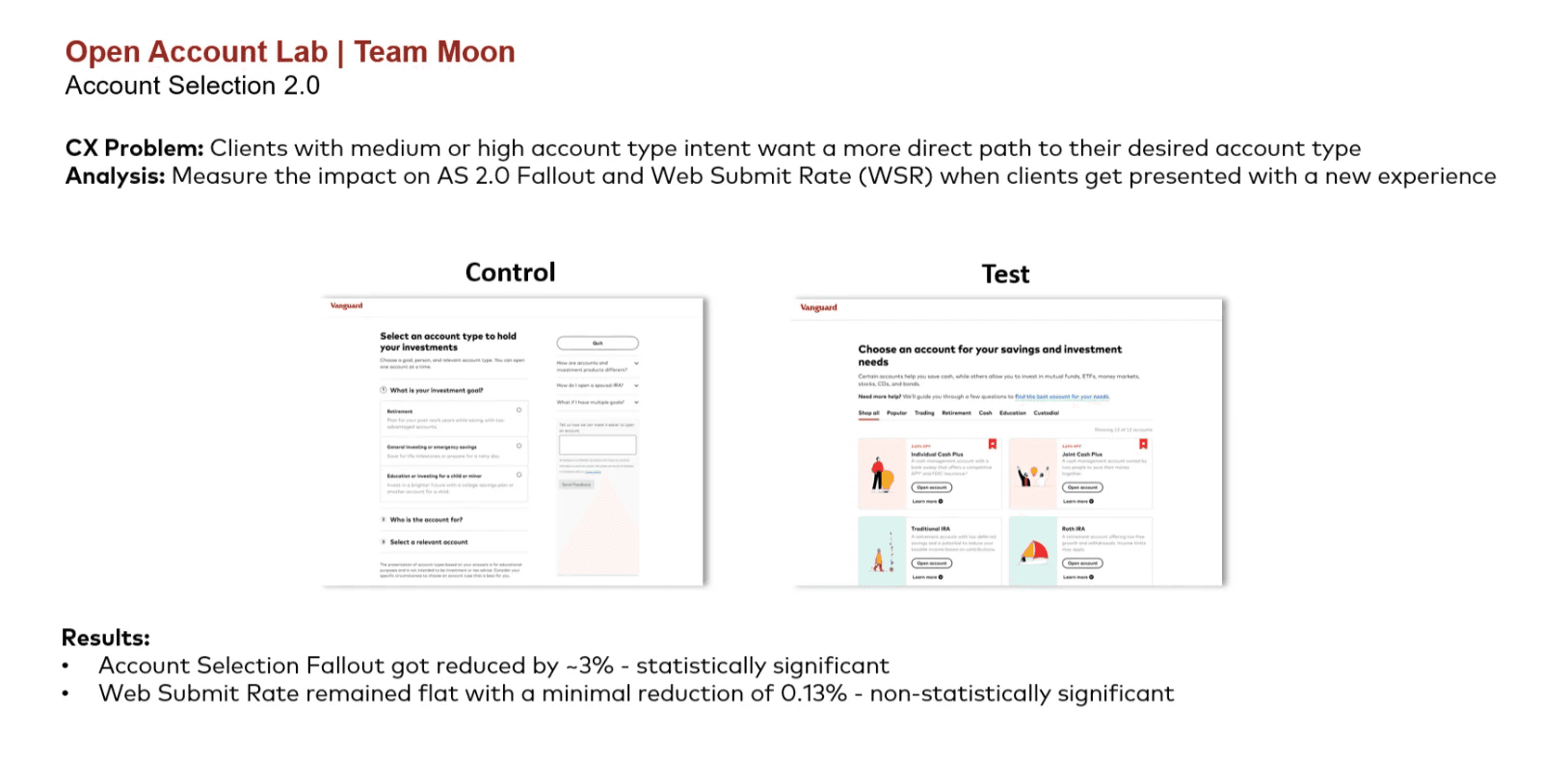
  • Ran a 90/10 experiment using progression through the account selection step as the primary success signal.

  • The experiment showed a +3% lift in progression, which secured buy-in to expand rollout.

Iteration (refinements driven by testing)

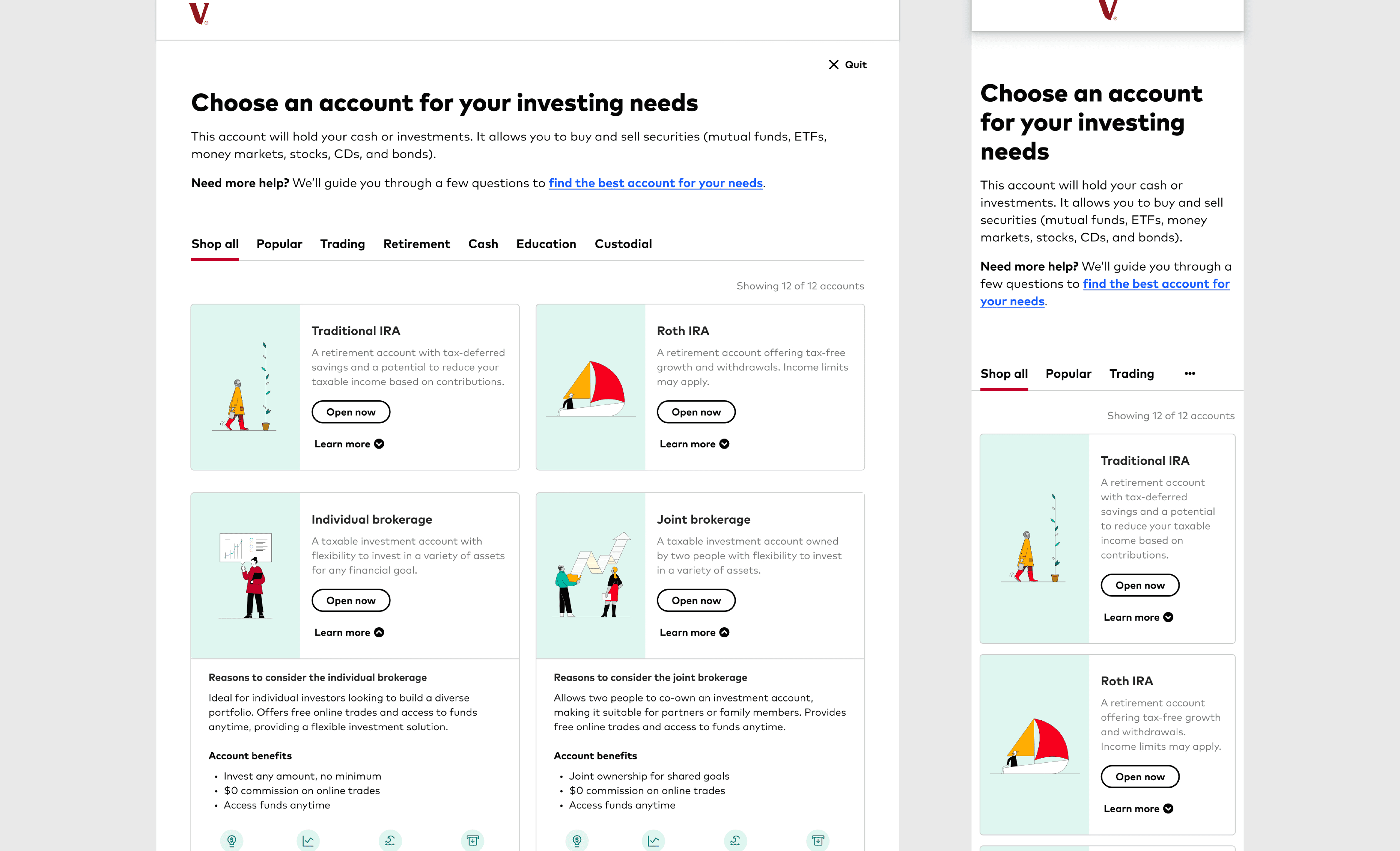
  • Improved scanability by tightening hierarchy and adjusting the content-to-image ratio so key decision data surfaced faster.

  • Refined responsive behavior across desktop, tablet, and mobile to preserve comparison utility in smaller viewports.

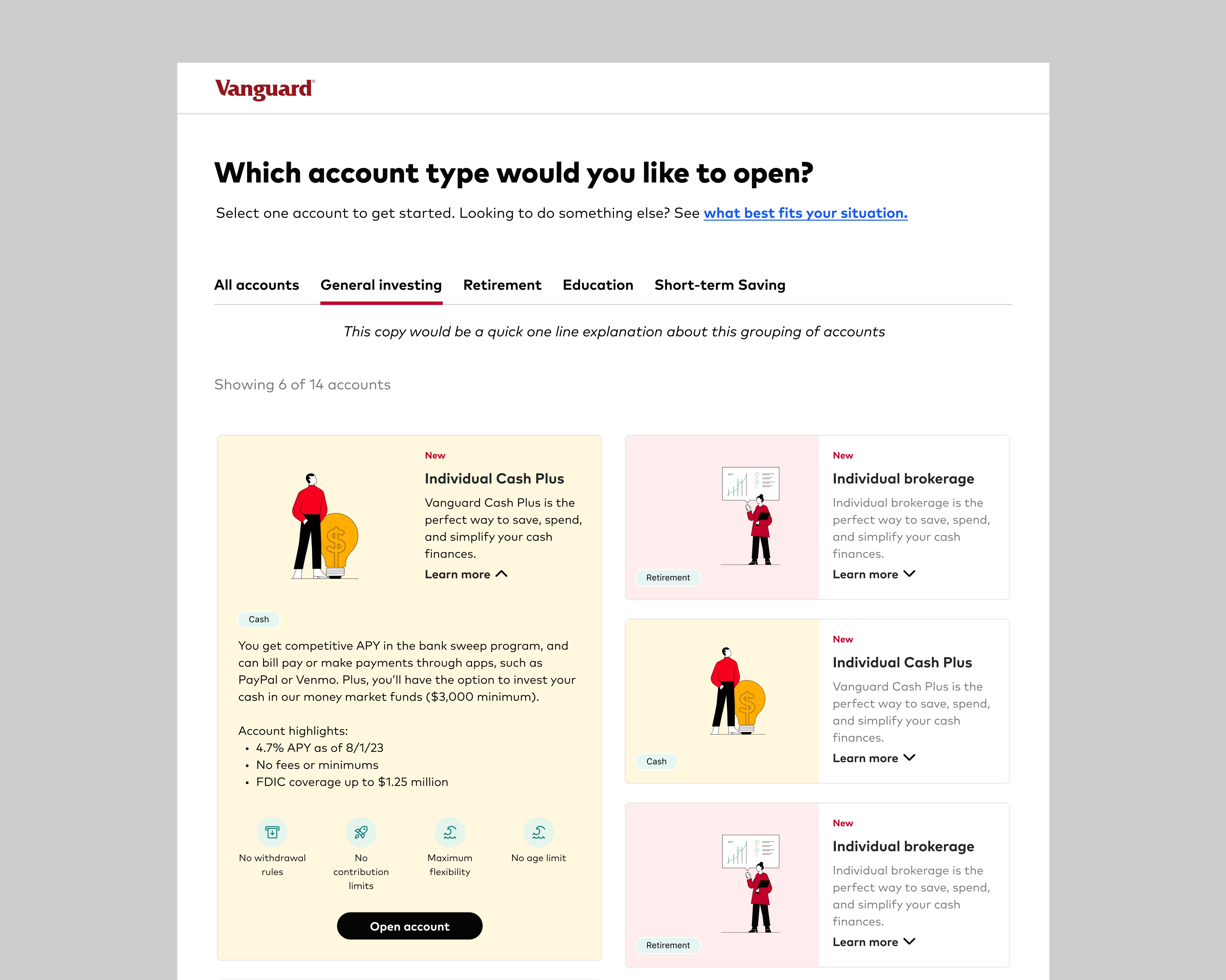
  • Enabled side-by-side comparison by allowing multiple cards to expand at once (vs. forcing single-focus evaluation).

  • Added lightweight filtering to help users narrow choices faster without turning the page into a multi-step wizard.

  • Included an escape hatch back to the guided stepper for users who wanted more structured support.

constraints & context

  • Regulated, high-trust environment: Language had to be precise, compliant, and confidence-building.

  • Cross-platform constraints: Needed to work cleanly across desktop + mobile with limited space for dense comparisons.

  • Design system alignment: Required fit within the existing dashboard/onboarding system (scalable patterns, not one-off UI).

  • Complexity + edge cases: Multiple account types and scenarios meant the model had to stay flexible without sacrificing consistency.

  • Incremental delivery: Solution had to be testable and shipped in stages (no “big bang” rebuild)

the impact


  • Validated the pattern with a 90/10 experiment before scaling.

  • Early signal: +3% lift in progression through the account selection step, which secured buy-in to expand rollout.

  • After scaling, the redesigned page contributed to a +23% increase in new account openings (QoQ).

  • What drove the lift: clearer comparison through expandable cards, faster narrowing via filtering, and an escape hatch for users who needed step-by-step guidance.
Key screens

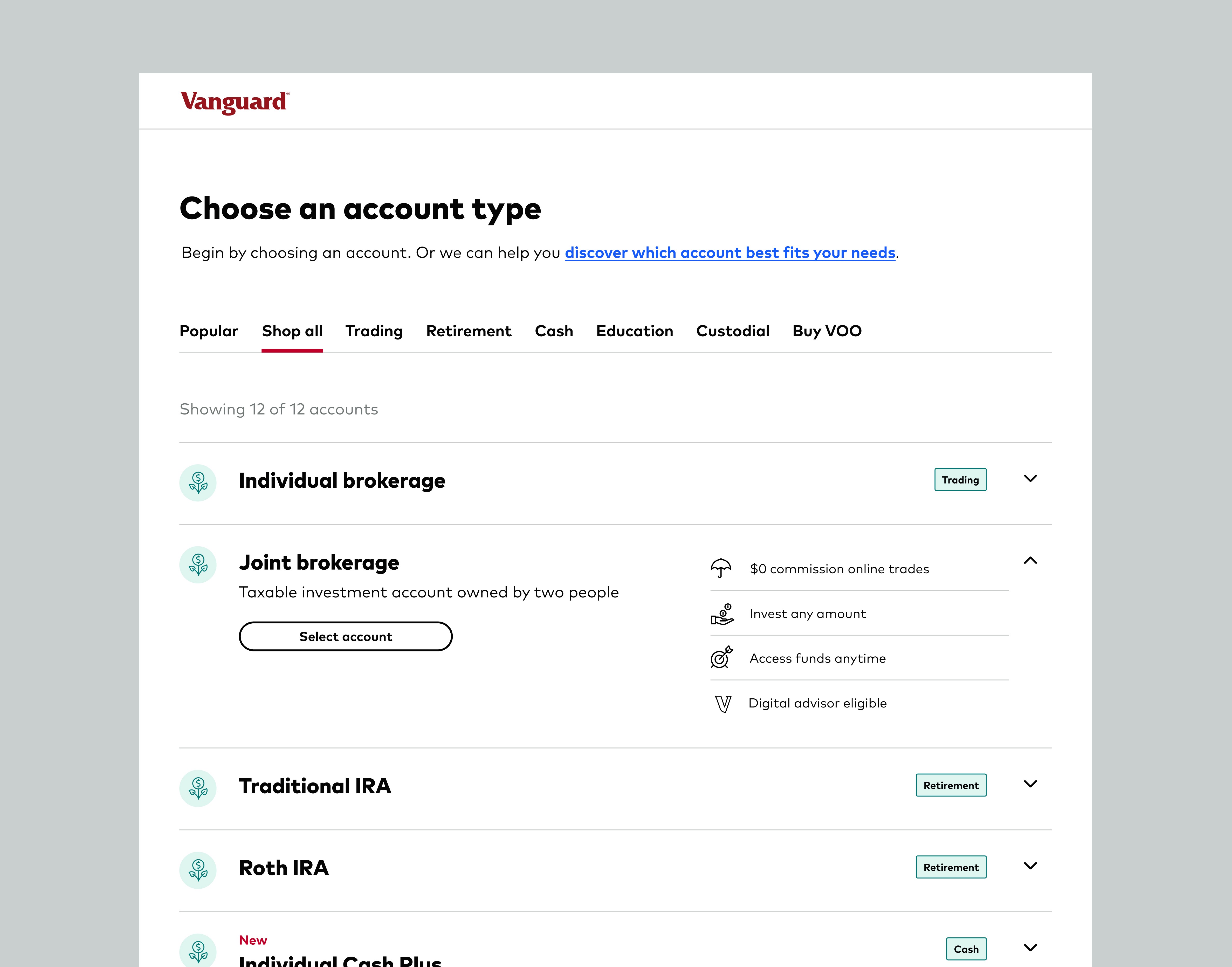
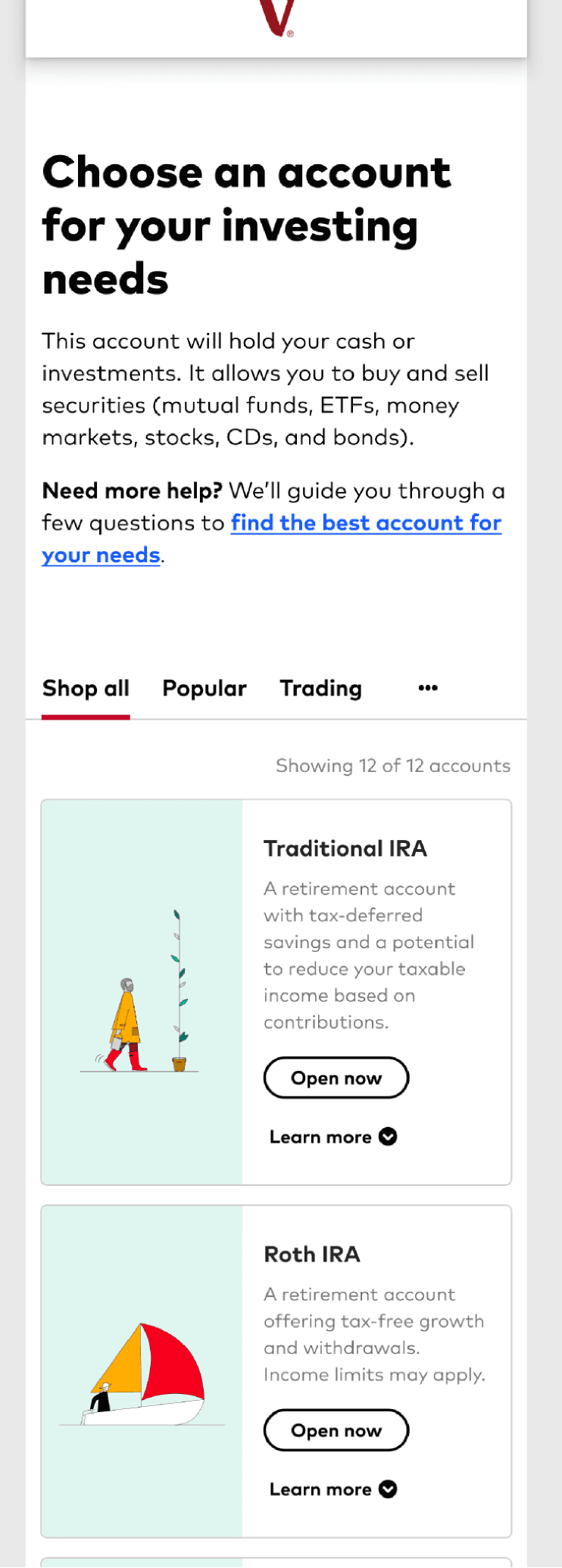
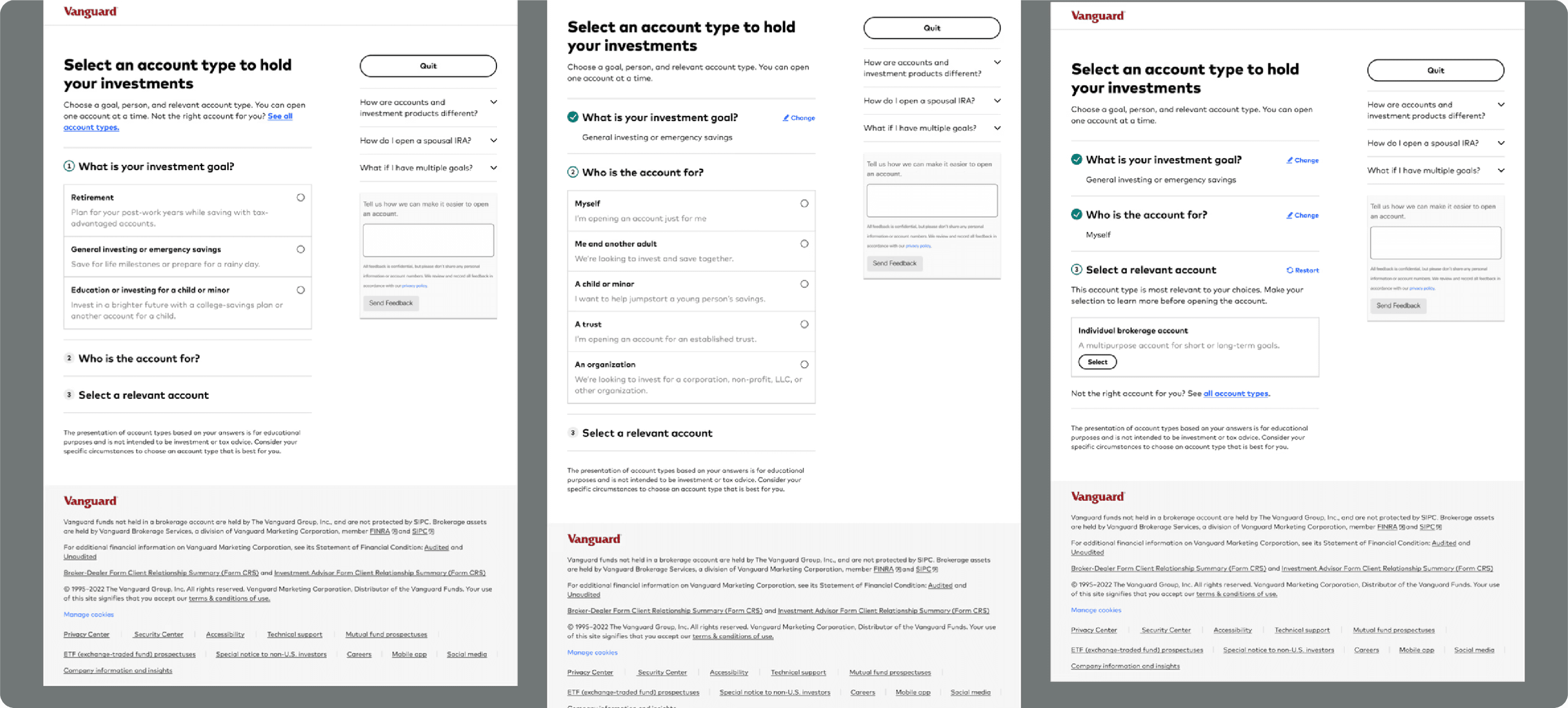
Before screens and a few iterations before final screens

Project overview

Luxe Beauty, a luxury cosmetics brand, aimed to enhance its digital footprint to better reflect its premium products and sophisticated brand identity. The goal was to create a visually stunning, user-friendly website that would attract high-end customers and provide a seamless shopping experience.

Next Projects